Teeth Whitening Services
A complete guide to the treatment itself, who it suits, how the appointment runs, and the aftercare that protects your result
Teeth Whitening is one of the most frequently requested cosmetic dental procedures in the United Kingdom, and it is also one of the most misunderstood. Many people arrive at their first appointment with expectations shaped by advertising, social media, or a friend's experience rather than by a clear explanation of what the process actually does. This page sets out, in practical detail, what our Teeth Whitening services involve from the moment you make an enquiry to the point months later when you are maintaining your result at home.
Throughout this page you will find explanations of the different Teeth Whitening approaches available, the assessment that precedes any treatment, the structure of a typical session, and the aftercare protocol that determines how long your results last. Where a procedure has limits, those limits are stated plainly. Where individual variation affects the outcome, that variation is described rather than glossed over.
If you would like to see the kinds of outcomes that Teeth Whitening produces, the results page explains how shade change is measured and documented. If cost is your immediate question, the prices page sets out what is included and what shapes the total. For the standards that underpin everything described here, see why choose us.
What Teeth Whitening Actually Involves
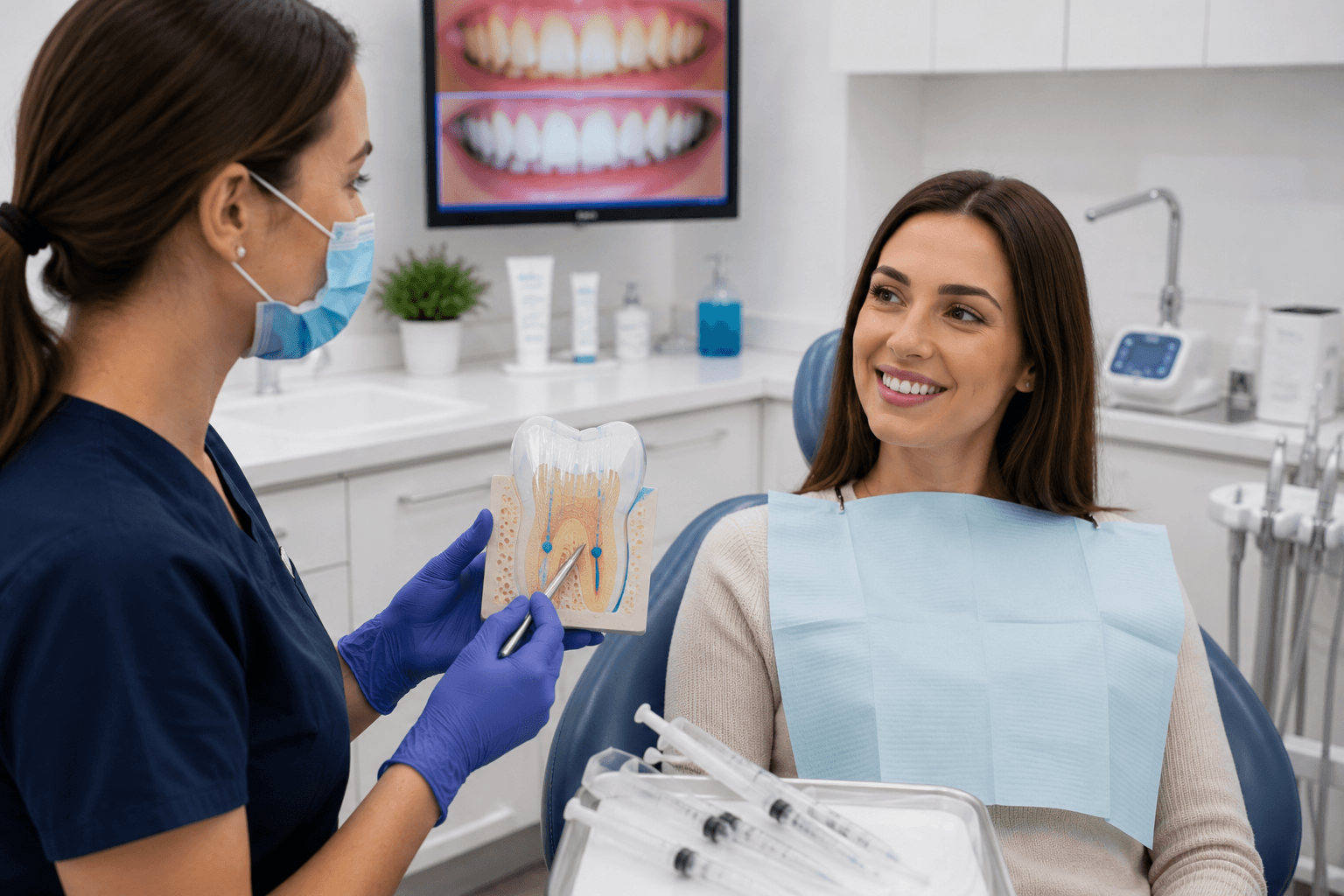
Teeth Whitening is a chemical process, not a mechanical one. Nothing is scraped, sanded, or filed away from the tooth. A whitening agent is placed in contact with the enamel surface, and the active ingredient in that agent diffuses through the enamel into the layer beneath, where the molecules responsible for discolouration sit. Those molecules are broken into smaller, less pigmented fragments. The tooth reflects more light as a result, and the eye reads that increased reflectance as a lighter shade.
This distinction between chemical and mechanical action matters enormously. Abrasive whitening products, charcoal powders, and household remedies work by scrubbing stain from the outer surface. That approach removes some surface discolouration, but it does so by removing a microscopic layer of tooth structure along with it. Repeated over months and years, abrasion thins enamel permanently, and thinner enamel allows more of the naturally yellow dentine underneath to show through. The long-term result of aggressive abrasive whitening is often darker teeth, not lighter ones.
Professional Teeth Whitening avoids that trap entirely. Because the mechanism is chemical diffusion rather than physical removal, the enamel surface remains intact when the treatment is correctly applied at appropriate concentrations and exposure times. The improvement comes from altering what is already inside the tooth rather than taking material off it.
The whitening agent needs time in contact with the tooth to work. This is why every Teeth Whitening system, regardless of format, involves a defined contact period. In-person sessions concentrate that contact into a single appointment using a series of timed application cycles. Home tray systems spread it across days or weeks using lower concentrations worn for longer. The total chemical exposure is what drives the result, and different systems simply distribute that exposure differently across time.
The One-Hour Session, Step by Step
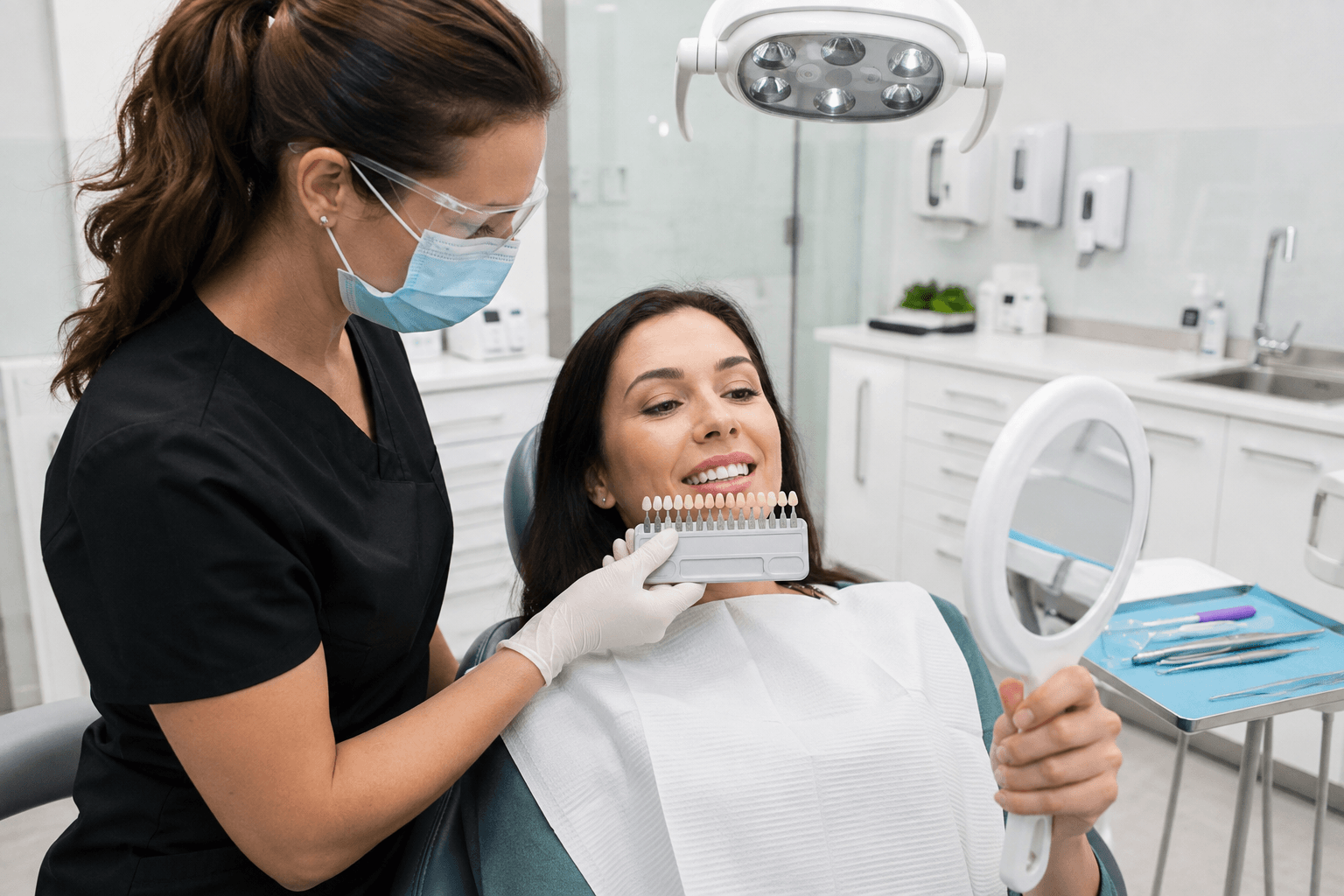
A single Teeth Whitening appointment typically runs for around sixty minutes from arrival to completion. That hour is not a single continuous application. It is a structured sequence of assessment, preparation, timed treatment cycles, and review. Knowing what each stage achieves removes most of the apprehension people bring to a first appointment.
Stage One: Consultation and Shade Assessment
Before any product is opened, the condition of your teeth and gums is checked. This is a screening rather than a full dental examination, and it looks for anything that would make whitening inadvisable on the day, including visible decay, obvious gum inflammation, exposed dentine, cracked enamel, or restorations positioned where they would create an uneven final appearance. The current shade of your teeth is then recorded against a standardised shade guide. That recorded starting point is what allows the change to be measured objectively afterwards rather than judged from memory.
Stage Two: Preparation and Soft Tissue Protection
The teeth are cleaned and dried so that the whitening agent contacts enamel directly rather than sitting on a film of plaque or saliva. Lips and cheeks are held clear using a retractor, which feels unfamiliar for the first minute or two and then becomes unremarkable. A protective barrier is applied along the gum line, covering the soft tissue immediately adjacent to each tooth while leaving the enamel exposed.
This barrier is the most important safety step in the entire appointment. Whitening agents are formulated for enamel, not for gum tissue, and prolonged contact with unprotected gingiva causes a temporary whitened patch and localised soreness. Careful barrier placement takes several minutes and is worth every second, and it is one of the clearest practical differences between supervised Teeth Whitening and an unsupervised home kit where no such protection exists.
Stage Three: Application and Timed Cycles
The whitening gel is applied evenly across the front surfaces of the teeth within the smile line. Coverage matters: patchy application produces patchy results, and an experienced practitioner works methodically across the arch rather than quickly. The gel is then left in contact for a defined period, commonly between ten and twenty minutes depending on the system in use.
At the end of each cycle the spent gel is removed and fresh product applied. Most Teeth Whitening protocols involve three cycles within the appointment. Splitting the exposure this way is deliberate. Fresh product maintains a consistent rate of reaction, and the short breaks between cycles give the practitioner a chance to check comfort and to inspect the gum barrier for any gaps that need attention.
Stage Four: Light Activation Where Used
Many Teeth Whitening systems incorporate a lamp directed at the teeth during each cycle. The stated purpose is to accelerate the breakdown of the active agent. It is worth being straightforward about the evidence here: research comparing light-activated protocols with identical protocols performed without a lamp has produced mixed findings, and several studies have found little meaningful difference in final shade once total exposure time is matched.
What this means practically is that the lamp is not the mechanism of whitening. The chemistry is. Systems that include activation are selected on the basis of their overall safety and efficacy record rather than on a claim that light alone produces the result. Any provider who presents a lamp as the primary reason their Teeth Whitening works is overstating the evidence.
Stage Five: Final Removal and Review
After the last cycle, all residual gel is removed thoroughly, the gum barrier is lifted away, and the mouth is rinsed. The retractor comes out and your teeth are checked against the same shade guide used at the start. Comparing the recorded starting shade with the finishing shade gives a measured change rather than an impression.
Stage Six: Aftercare Briefing
The final few minutes cover what happens next. Immediately after Teeth Whitening the enamel is temporarily more receptive to staining, which makes the first day or two the single most influential period for your long-term result. You should leave the appointment knowing exactly what to avoid, for how long, and what to do if you experience any sensitivity overnight. Aftercare given verbally and in writing is retained far better than aftercare mentioned in passing while you are putting your coat on.
Home-Visit Teeth Whitening
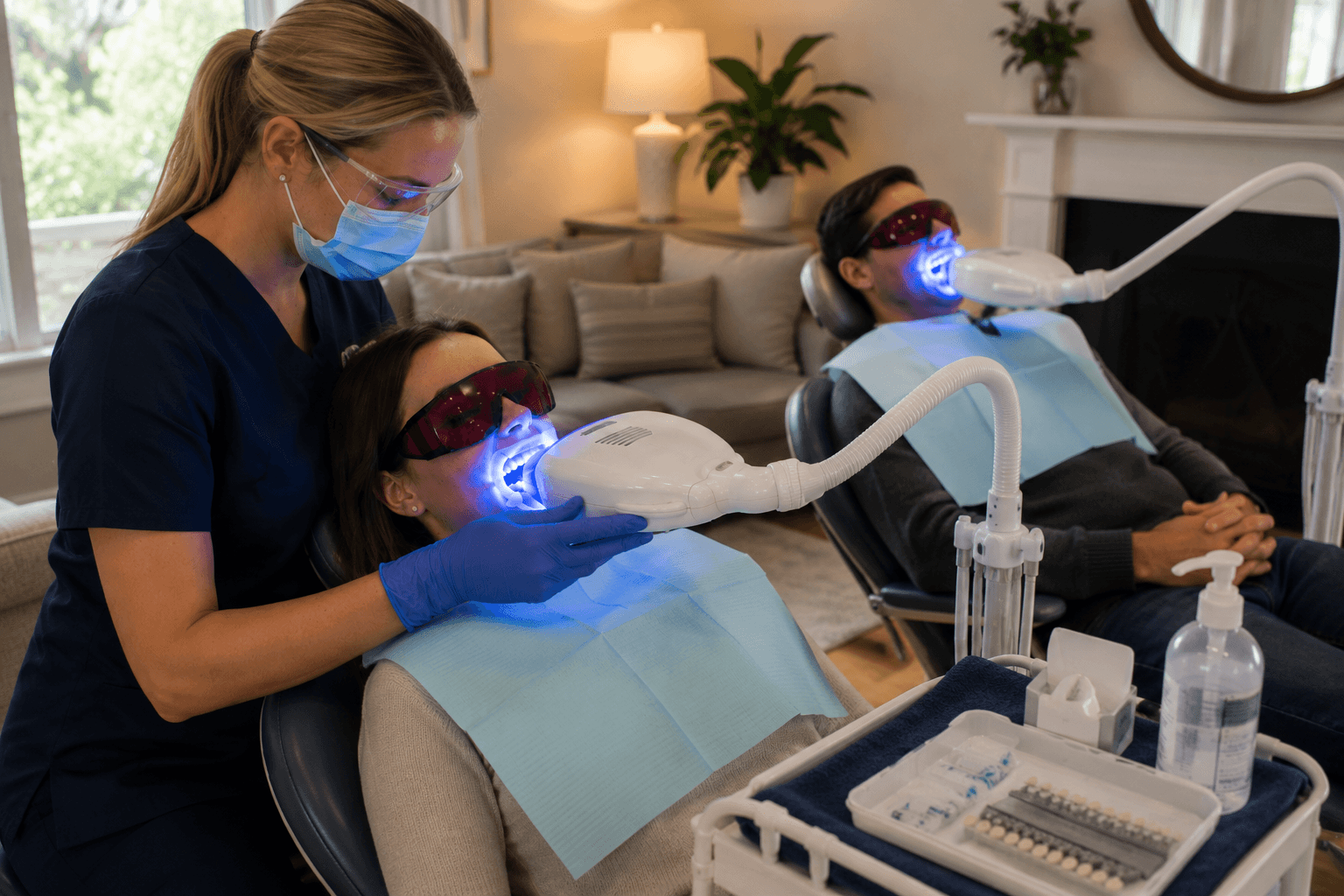
Teeth Whitening delivered at your home follows exactly the same clinical sequence as a session in a treatment room. The assessment, the soft tissue protection, the timed cycles, and the shade recording are identical. What changes is the setting, and that change removes several practical barriers that stop people booking at all.
If you are considering professional Teeth Whitening and want to understand the service approach before booking, you can learn more about Ultimawhite Hove and the professional whitening services available.
The second benefit is comfort. A significant proportion of the population experiences meaningful anxiety about dental settings, and for some that anxiety is severe enough to prevent them seeking any treatment at all. The clinical environment itself, with its sounds and smells, is often the trigger rather than the procedure. Receiving Teeth Whitening in a familiar room, seated in your own chair, removes those environmental cues entirely. People who have avoided treatment for years frequently find a home appointment manageable when a clinic appointment was not.
Two-person bookings work particularly well in a home setting. Where two people at the same address are treated in one visit, the sessions run consecutively and the total appointment lasts around two hours. This is a common arrangement for couples, siblings, friends, and people preparing for the same event, and it is also the arrangement that produces the lowest cost per person, as set out on the prices page.
Infection control standards do not relax because the setting is domestic. Single-use items are used once and disposed of, reusable equipment is decontaminated between clients, and hand hygiene follows the same protocol used in any clinical environment. A home visit is a change of venue, not a change of standard.
Choosing Between Whitening Systems
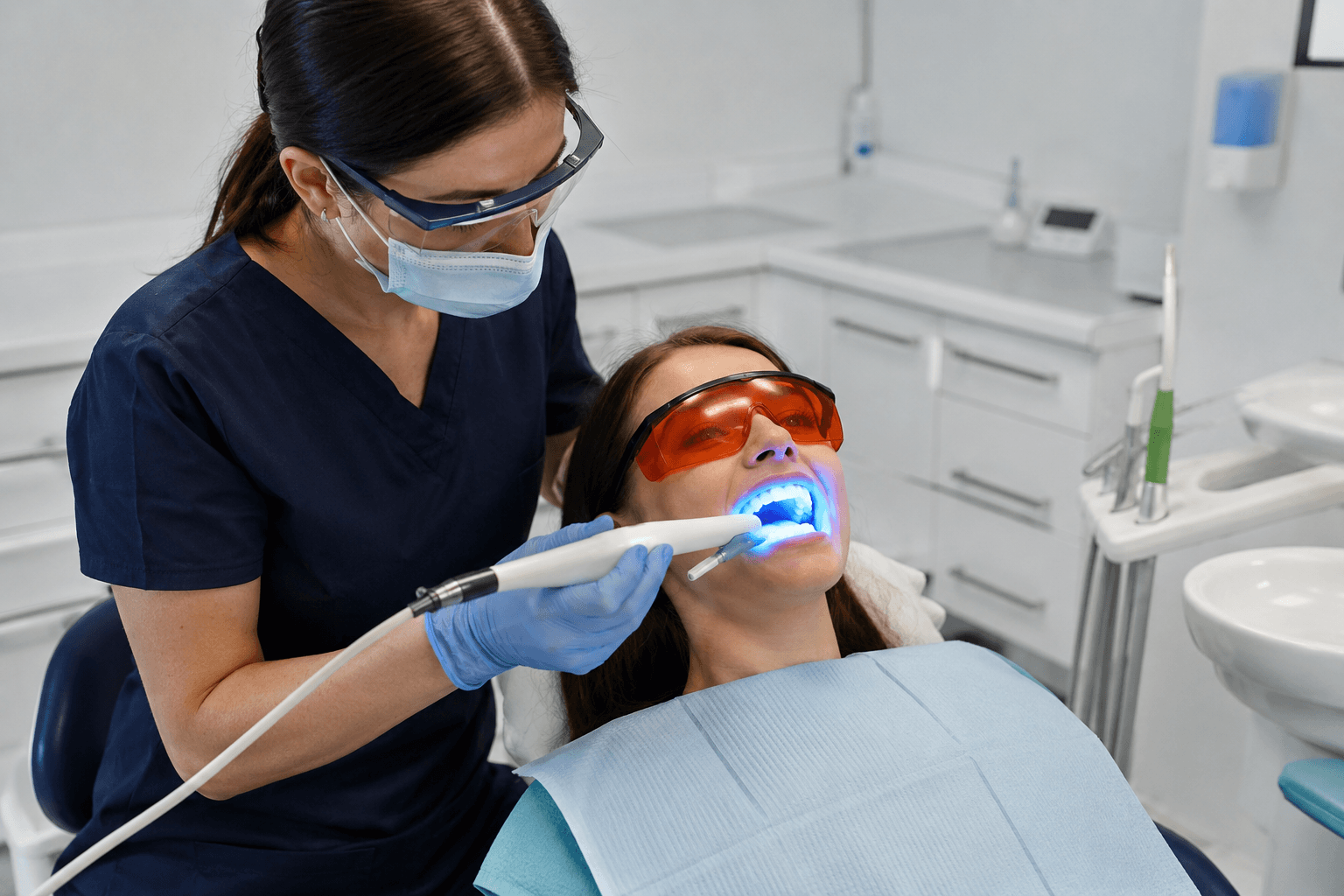
Not all Teeth Whitening is the same, and the differences between systems are frequently obscured by marketing language. The four broad categories below cover almost everything available in the UK, and each has a genuine place depending on circumstances.
Peroxide-Based Systems
Hydrogen peroxide and carbamide peroxide are the most extensively studied whitening agents, with decades of clinical literature behind them. They are effective, predictable, and well characterised. In the United Kingdom their use is tightly regulated: products containing or releasing hydrogen peroxide at concentrations between 0.1% and 6% may only be supplied to dental practitioners, and the first application in any treatment cycle must be carried out by a dental practitioner or under their direct supervision. Products above those limits are not permitted for cosmetic use.
Non-Peroxide Systems
Non-peroxide Teeth Whitening formulations use alternative active chemistries, most commonly based on sodium bicarbonate, sodium perborate derivatives, or phthalimidoperoxycaproic acid. These are widely marketed as gentler alternatives, and users generally report noticeably less sensitivity than with peroxide systems.
Honesty requires two caveats. First, the published evidence base for non-peroxide chemistry is smaller than for peroxide, simply because peroxide has been studied for far longer. Second, some non-peroxide compounds release small amounts of peroxide as part of their reaction pathway, which means the regulatory position depends on the specific formulation rather than on the marketing description. A provider should be able to tell you exactly which active ingredient their Teeth Whitening product contains and at what concentration. If that question cannot be answered directly, treat it as a warning sign.
Dentist-Prescribed Home Tray Systems
Custom trays are made from impressions or a digital scan of your teeth, and a prescribed gel is supplied for use at home over a period of days or weeks. Because the trays fit precisely, the gel stays where it is intended and gum contact is minimised. This approach offers the finest control over the final shade, because you can stop when you reach the result you want and pause if sensitivity develops.
Tray systems suit people who prefer gradual change, who have experienced sensitivity previously, or who want the ability to top up at home in future. The obvious cost is time and consistency: results depend on wearing the trays as instructed across the full course, and people who use them intermittently see correspondingly patchy outcomes.
Over-the-Counter Products
Strips, pens, whitening toothpastes, and mouthwashes sold directly to consumers are legally restricted to very low peroxide concentrations, typically around 0.1%. At that level a meaningful shade change is unlikely, and most of the visible benefit comes from removing surface film rather than altering the colour of the tooth itself.
Assessing Whether Teeth Whitening Suits You
Most adults with generally healthy teeth are suitable candidates for Teeth Whitening, but suitability is a clinical judgement made after looking in your mouth rather than an assumption made when booking. The factors below all influence that judgement.
The Type of Staining You Have
Extrinsic staining sits on the outer enamel surface and comes from pigments in what you eat, drink, and smoke. Coffee, tea, red wine, dark fizzy drinks, richly coloured sauces, and tobacco are the usual sources. This category responds most reliably to Teeth Whitening, often with a clearly visible change after a single session.
Intrinsic staining sits within the tooth structure and arises from developmental factors, certain medications taken during tooth formation, trauma to an individual tooth, or root canal treatment. Intrinsic discolouration can improve with whitening, but the change is usually more gradual and sometimes more modest. Tetracycline banding in particular is well known to be resistant, often requiring extended treatment for partial improvement.
Age-related darkening is a third category and reflects gradual enamel thinning combined with dentine becoming naturally darker over the decades. It generally responds well, though the extent of improvement depends on how much enamel remains.
Existing Restorations
Crowns, veneers, composite fillings, and bridges do not change colour in response to whitening agents. This is a chemical fact rather than a limitation of any particular Teeth Whitening system, and no product on the market alters it. If you have visible restorations in the smile zone, whitening the surrounding natural teeth will make those restorations appear comparatively darker.
The correct approach is to plan for it. Whitening first, allowing the shade to stabilise for around two weeks, and then having restorations replaced to match the new shade produces a uniform result. Doing it in the reverse order does not work, because a newly matched restoration will be left behind when the surrounding teeth lighten.
Conditions That Require Attention First
Active decay, untreated gum disease, exposed dentine, significant enamel erosion, and cracked or chipped teeth all need addressing before Teeth Whitening rather than after. Whitening agent reaching an area of exposed dentine or an open cavity causes considerable discomfort and does nothing helpful. None of these findings rules out whitening permanently; they simply establish a sequence.
Age and Pregnancy
Current UK regulations restrict the use of products containing or releasing between 0.1% and 6% hydrogen peroxide in anyone under eighteen, other than where used to treat or prevent disease. Any provider willing to whiten a person under eighteen for cosmetic reasons is operating outside the regulations.
Elective Teeth Whitening is generally deferred during pregnancy and breastfeeding. There is no established evidence of harm, and the rationale is precautionary rather than a response to known risk. Deferring an entirely elective cosmetic procedure for a defined period is a reasonable and standard precaution.
Twelve Reasons People Choose Teeth Whitening
When people explain why they booked, the same themes recur. Setting them out individually gives a clearer picture of what the treatment offers than a general claim about confidence.
1. Results Appear Straight Away
An in-person Teeth Whitening session produces visible change within the appointment itself. There is no interval of wondering whether the product is working and no gradual accumulation to monitor. For anyone with a fixed date approaching, that immediacy is often the deciding factor.
2. Milder Options Exist for Sensitive Teeth
The prospect of sensitivity stops a great many people from ever trying Teeth Whitening. Non-peroxide formulations give those people a route in, and desensitising preparations reduce discomfort further for anyone using peroxide-based systems.
3. Sharp Sensitivity Is Not Inevitable
Most people who complete a supervised session describe it as unremarkable. Where sensitivity does occur it is typically brief, appearing within hours and settling within a day or two. Knowing the realistic likelihood in advance makes the prospect far less daunting than the anecdotes people repeat to each other.
4. The Enamel Surface Is Preserved
Because Teeth Whitening lifts pigment chemically rather than abrading it away, the enamel surface is not worn down. This is the fundamental advantage over whitening powders and household remedies, which trade a short-term surface improvement for permanent structural loss.
5. Trained Application Produces Even Coverage
Uneven results are the most common complaint about home kits, and the cause is almost always application. One-size trays leak and strips do not conform to individual tooth contours. A trained practitioner achieves consistent coverage across every tooth in the smile line.
6. Confidence Effects Are Consistently Reported
People frequently describe smiling more freely and worrying less about their teeth in photographs and conversation. These outcomes are subjective and vary by individual, but they are reported often enough to be worth naming as a genuine motivation.
7. Everyday Staining Is Addressed Directly
Coffee, tea, red wine, tobacco, and time account for most of the discolouration people want removed. These are precisely the extrinsic stains that Teeth Whitening handles most reliably, so the most common complaint is also the one with the best prognosis.
8. The Process Requires Nothing of You Afterwards
A single-session appointment involves no trays to wear at home and no nightly routine. Beyond the short aftercare window there is no ongoing commitment, which for many people is the difference between a result and an abandoned kit in a drawer.
9. It Fits Around Significant Events
Weddings, milestone birthdays, graduations, and interviews are common reasons for booking. The predictable timescale is what makes this practical: a session two to three weeks beforehand allows the shade to settle and any sensitivity to resolve.
10. Results Persist With Reasonable Care
With normal brushing, flossing, and some awareness of staining foods and drinks, the improvement typically holds for many months. Where gradual relapse occurs, a top-up restores the shade without repeating the full process.
11. Most Adults Are Suitable
You do not need exceptional teeth to benefit. Generally dull, yellowed, or evenly stained teeth are the typical starting point, and that describes a very large proportion of adults. A short consultation establishes suitability quickly.
12. It Is Straightforward and Reversible in Effect
Teeth Whitening does not permanently alter the structure of your teeth; the colour change fades gradually rather than locking you into a decision. For anyone wary of irreversible cosmetic procedures, that is a meaningful distinction.
Aftercare: The First Forty-Eight Hours
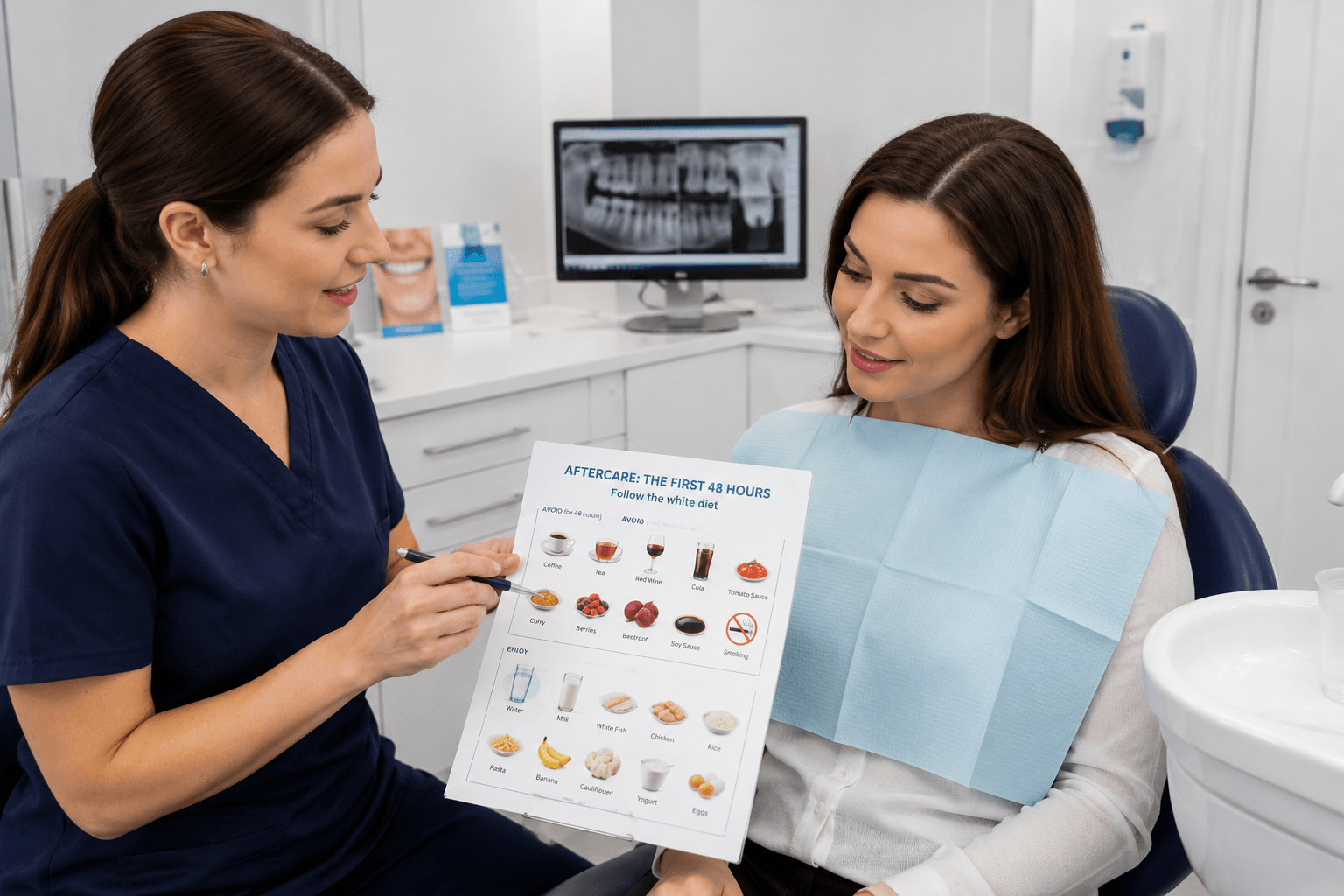
The two days following Teeth Whitening influence your long-term result more than any other period. Immediately after treatment the enamel is temporarily more porous than usual, and the protein layer that normally coats the tooth surface and acts as a partial barrier to pigment has been disrupted. Both effects are short-lived, but while they persist your teeth absorb colour far more readily than normal.
The practical response is what is commonly called the white diet: for forty-eight hours, avoid anything that would stain a white shirt. That single rule is easier to remember than any list, and it is accurate almost every time.
What to Avoid
- Coffee and tea, including green tea, which stains more than most people expect
- Red wine, and dark fruit juices such as blackcurrant, cranberry, and grape
- Dark fizzy drinks, which combine pigment with acidity
- Curry, soy sauce, balsamic vinegar, and tomato-based sauces
- Berries, beetroot, and brightly coloured sweets
- Tobacco in any form, which is the single most aggressive staining agent in this window
- Coloured mouthwashes, which are easy to overlook because they are part of an oral hygiene routine
What Is Safe
- Water, which should be your default drink throughout this period
- Milk and plain yoghurt
- Plain chicken, turkey, and white fish
- Rice, plain pasta, potatoes, and bread
- Cauliflower, white onion, and other pale vegetables
- Peeled apples, pears, and bananas
If avoiding coffee or tea outright is unrealistic, two adjustments reduce the damage. Drinking through a straw limits contact with the front surfaces of the teeth, which are the ones that show. Rinsing with water immediately afterwards clears residual pigment before it settles. Neither is as effective as abstaining, but both are considerably better than nothing.
Daily Habits That Protect Your Results
Beyond the initial window, maintaining a Teeth Whitening result comes down to consistency rather than complexity. Four habits account for almost all of the difference between a result that lasts and one that fades quickly.
Brush Thoroughly Twice a Day
Two minutes, twice daily, with a soft-bristled brush and fluoride toothpaste. Soft bristles are specified deliberately: harder bristles do not clean more effectively and do contribute to gum recession and enamel wear over time. Technique matters more than pressure, and short circular movements angled towards the gum line remove more plaque than vigorous scrubbing.
Leave a gap of around thirty minutes between eating and brushing, particularly after anything acidic. Acid softens the enamel surface temporarily, and brushing during that window removes more mineral than brushing later would.
Clean Between the Teeth Every Day
Interdental surfaces make up a substantial proportion of the total tooth area, and a brush reaches almost none of it. Floss or interdental brushes remove the plaque and trapped pigment that accumulates in those gaps. This is also where staining becomes most visible over time, appearing as darker lines between teeth that no amount of surface brushing will shift.
Drink Water Through the Day
Water rinses pigment away before it settles and supports saliva flow, which is the mouth's own defence against both staining and decay. This is one of the least demanding and most effective habits available, and it costs nothing.
Rinse After Staining Food or Drink
When brushing is not practical, a mouthful of water swished briefly removes a meaningful proportion of residual pigment. Over months, the cumulative effect of rinsing after every coffee is considerable. It is the habit most people find easiest to adopt permanently.
Keep Routine Dental Appointments
Professional cleaning removes hardened deposits and surface staining that home care cannot address, and routine examination catches problems while they remain small. Regular hygiene visits are the most reliable way to extend a Teeth Whitening result without repeating treatment, and they serve your general oral health at the same time.
Managing Sensitivity and Comfort
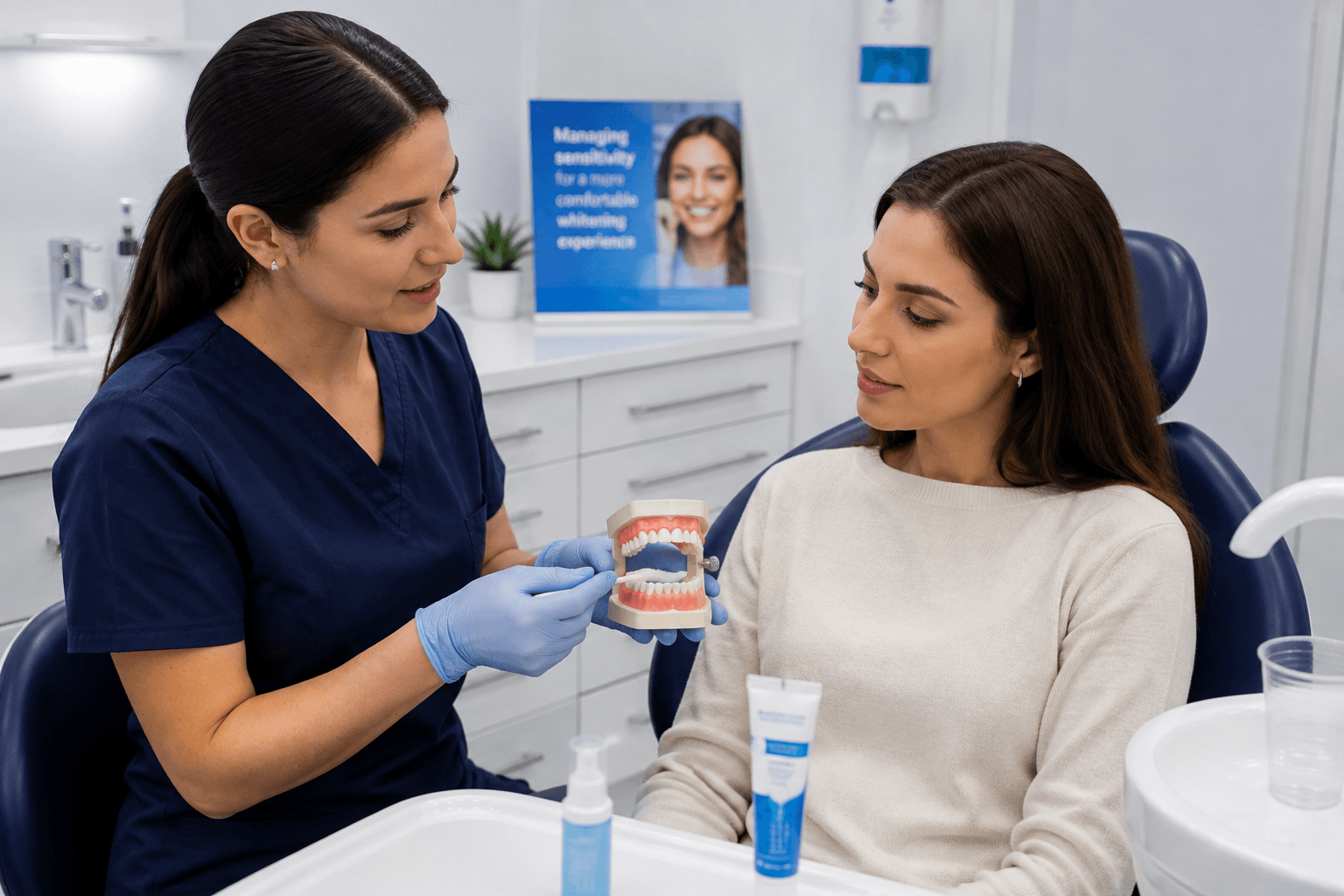
Transient sensitivity is the most frequently reported side effect of Teeth Whitening. It presents as brief sharp sensations, usually in response to cold air or cold drinks, and it typically appears within the first few hours and resolves within twenty-four to forty-eight hours. It is uncomfortable rather than harmful, and it does not indicate damage.
Reducing the Likelihood Beforehand
Using a desensitising toothpaste containing potassium nitrate or stannous fluoride for one to two weeks before your appointment reduces the incidence and severity of post-treatment sensitivity. The active ingredients need time to accumulate, so starting the day before offers little benefit. If you know you have sensitive teeth generally, mention it at booking rather than at the appointment, so that the protocol can be adjusted in advance.
Adjustments During Treatment
Where sensitivity is anticipated, several modifications help: shorter application cycles, a lower concentration product, fewer total cycles in one session, or a desensitising gel applied immediately after the final cycle. Any of these slightly reduces the shade change achieved in one visit, and that trade-off is worth discussing openly rather than discovering afterwards.
What Helps Afterwards
- Continue with desensitising toothpaste for a week or two after treatment
- Avoid very cold and very hot food and drink for the first day
- Breathe through your nose in cold air, as cold air across the teeth is a common trigger
- Use lukewarm water for brushing rather than cold
Sensitivity that persists beyond a few days, or pain that is localised to one specific tooth rather than generalised, is not a normal outcome of Teeth Whitening and should be assessed by a dentist. Localised persistent pain more often indicates an underlying problem such as a crack, a failing restoration, or decay that was not visible at screening.
Top-Up Sessions and Long-Term Maintenance
Teeth Whitening is not permanent. Your teeth begin accumulating new surface stain from the day after treatment, at a rate determined almost entirely by diet and smoking. Understanding this from the outset frames whitening correctly as something you maintain rather than something you complete.
Relapse is gradual and largely invisible day to day, which is why comparing against a recorded starting shade or a dated photograph is more reliable than memory. Many people notice nothing for months and then find the change obvious when they see an older picture.
A top-up session is shorter than an initial Teeth Whitening appointment, because it starts from an already lightened baseline and involves fewer cycles. Where custom trays have been made, a single night's use of prescribed gel is often enough to restore the shade, which makes tray-based maintenance economical over several years.
What Teeth Whitening Cannot Do
Being clear about limits is part of an honest service, and the following are the things Teeth Whitening genuinely cannot achieve regardless of the system used or the number of sessions undertaken.
- Change the colour of crowns, veneers, bridges, or composite fillings. Ceramic and resin do not respond to whitening chemistry. Restorations must be replaced if they are to match a new shade.
- Correct the shape, alignment, or spacing of teeth. Whitening changes colour only. Crowding, gaps, chips, and rotations require orthodontic or restorative treatment.
- Fully remove severe tetracycline banding. Deep intrinsic banding may lighten partially with extended treatment, but complete resolution is uncommon and veneers are often the more realistic route.
- Whiten a single dark non-vital tooth to match its neighbours. A tooth darkened by trauma or root canal treatment usually requires internal bleaching, a distinct procedure carried out by a dentist from inside the tooth.
- Produce an unnatural opaque brightness. The upper limit is the natural colour of your own dentine with the pigment removed. The uniformly opaque appearance seen in some photographs is produced by veneers or by image editing, not by whitening.
- Treat decay or gum disease. Whitening is cosmetic and addresses neither. Disease must be treated first, by a dentist.
None of these limits makes Teeth Whitening a poor choice. They simply define what it is for. A treatment that reliably does one thing well, honestly described, serves people better than one that is claimed to do everything.
Preparing for Your Appointment
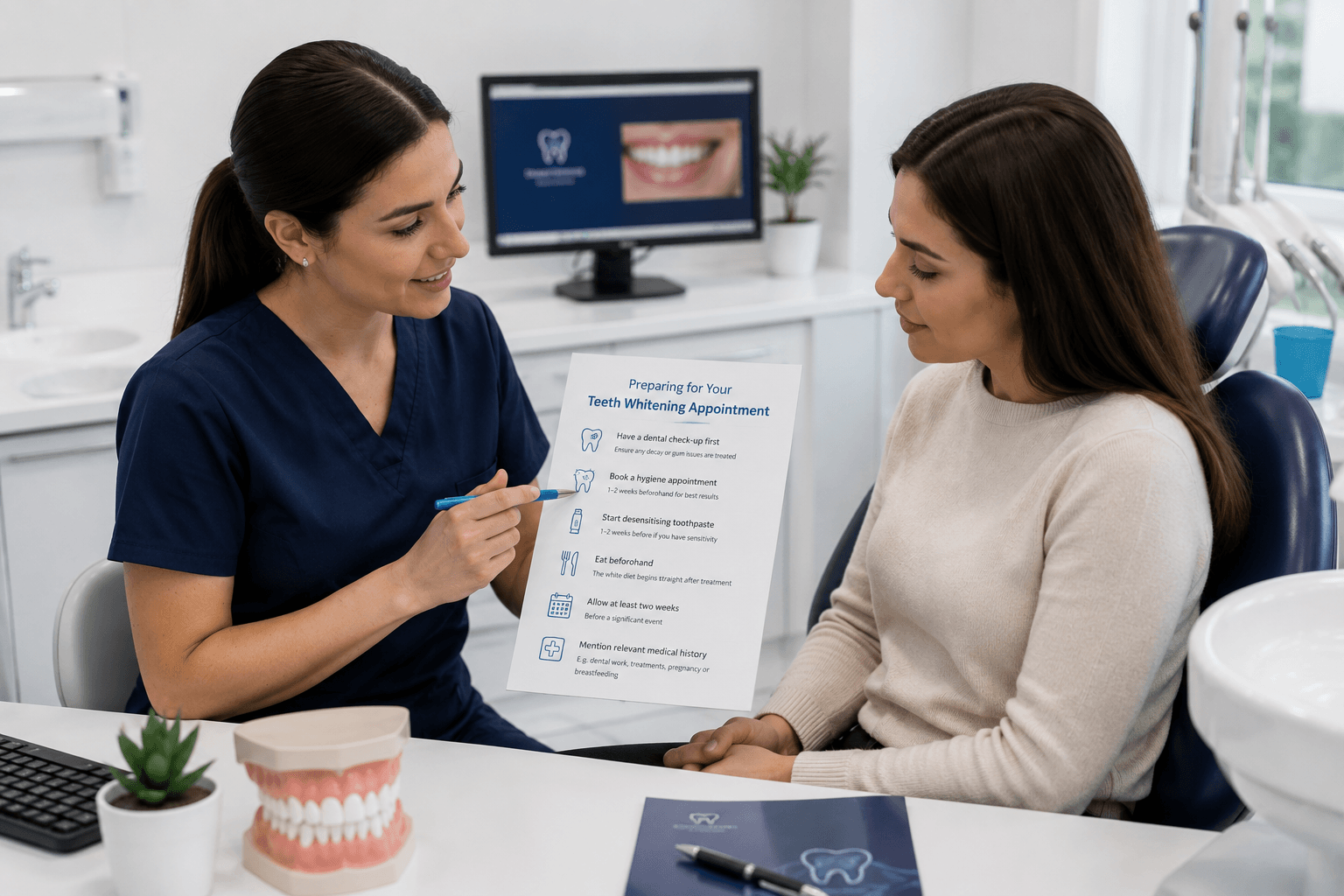
A small amount of preparation improves both the comfort and the outcome of a Teeth Whitening session.
Choosing a professional provider is an important part of preparing for treatment. Understanding the treatment process, professional standards, and what to expect can help you make a more informed decision. For further information, see the Ultimawhite Watford approach.
- Have a dental check-up first if you are overdue one. Undiagnosed decay or gum inflammation should be treated before whitening, and finding out at your appointment wastes everyone's time.
- Book a hygiene appointment one to two weeks beforehand where possible. Removing hardened deposits and surface film first means the whitening agent contacts clean enamel across the whole tooth, which produces a more even result.
- Start desensitising toothpaste one to two weeks before if you have any history of sensitivity.
- Eat beforehand. The white diet begins straight after treatment, so a meal before the appointment is more convenient than one after it.
- Allow at least two weeks before a significant event. This leaves room for the shade to stabilise and for any transient sensitivity to settle.
- Mention relevant medical history. Recent dental work, ongoing treatment, pregnancy, or breastfeeding all affect the plan and should be disclosed before treatment rather than during it.
Frequently Asked Questions
A single-person session runs to approximately sixty minutes including consultation, shade recording, preparation, the treatment cycles themselves, and the aftercare briefing. A two-person booking at the same address takes around two hours, as the sessions run consecutively.
The procedure itself is not painful. The most common discomfort is the retractor holding the lips clear, which feels unfamiliar for the first few minutes. Some people experience brief sharp sensitivity in the hours afterwards, typically settling within a day or two. Non-peroxide systems and desensitising preparations reduce this considerably.
This depends on your starting shade, the type of staining, and your enamel. Extrinsic staining generally responds most and most quickly. Rather than promising a number, a responsible provider records your starting shade and measures the change achieved, so the outcome is documented rather than estimated.
Longevity depends almost entirely on diet, smoking, and oral hygiene. Someone who drinks mainly water and does not smoke retains a result far longer than a heavy coffee drinker who smokes. Good habits and occasional top-ups extend it considerably in either case.
Whitening carried out at appropriate concentrations and exposure times under supervision does not remove or thin enamel, because it works by chemical diffusion rather than abrasion. The genuine risks to enamel come from abrasive home remedies and from unsupervised use of unregulated high-concentration products.
Yes, but the restorations will not change colour, so they will appear comparatively darker once the surrounding natural teeth lighten. The usual sequence is to whiten first, allow around two weeks for the shade to stabilise, and then have visible restorations replaced to match.
Where to Go Next
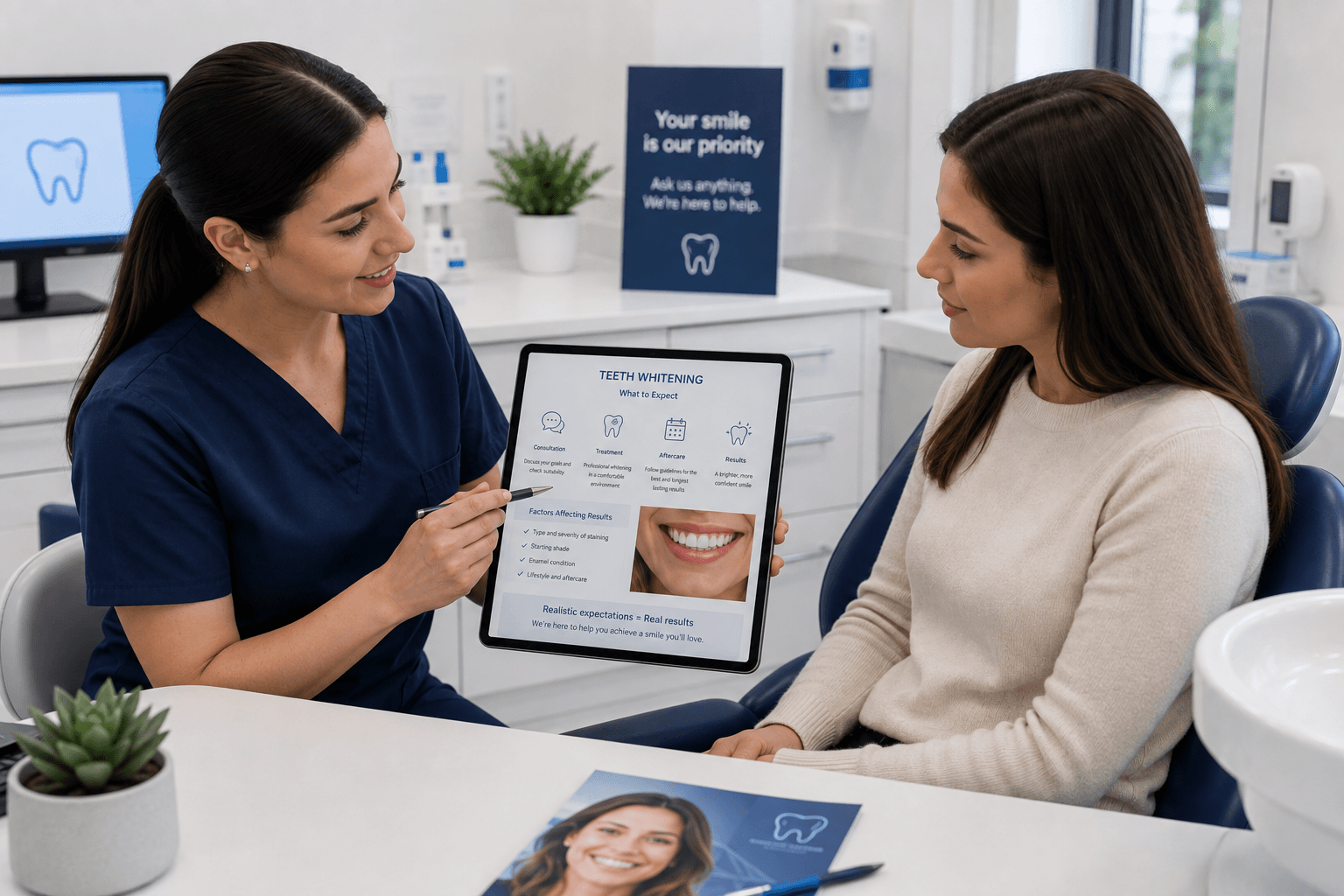
Teeth Whitening is a straightforward procedure with a well-understood mechanism, a predictable timescale, and clearly defined limits. The people who are most satisfied with it are consistently those who understood all three before they booked.
If you have questions about your suitability, treatment options, or the appointment process, the next step is to speak with the provider directly. You can use Ultimawhite Watford contact details to make an enquiry.