Teeth Whitening Services Explained
Teeth Whitening is often talked about as though it were one procedure with one outcome. In practice it is a small family of related services, and the differences between them matter a great deal to the person sitting in the chair. The staining that builds up on a daily coffee drinker's teeth is not the same problem as the discolouration that arrives with age, and neither is approached in the same way as whitening on teeth that already twinge at cold water.
This page sets out the Teeth Whitening services described across this site, what each one is actually for, and how to work out which conversation you should be having. It is written to be read before an appointment rather than after one, because the most common source of disappointment in cosmetic dentistry is not the treatment itself - it is a mismatch between what someone expected and what the treatment was ever going to do.
Every service described below shares the same spine. An assessment establishes what is causing the discolouration and whether the teeth and gums are healthy enough for cosmetic treatment. A plan is agreed that reflects the individual mouth rather than a template. The treatment is carried out with the soft tissues protected and comfort monitored throughout. Afterwards, the result is reviewed honestly against what was discussed at the start, and aftercare guidance is given. What changes between services is the emphasis, the pacing, and the expectations that are reasonable to set.
Nothing on this page is a substitute for an examination. General information can tell you what a service involves and who it tends to suit; only a dental professional looking at your teeth can tell you whether it suits you.
Assessment: The Service That Comes First
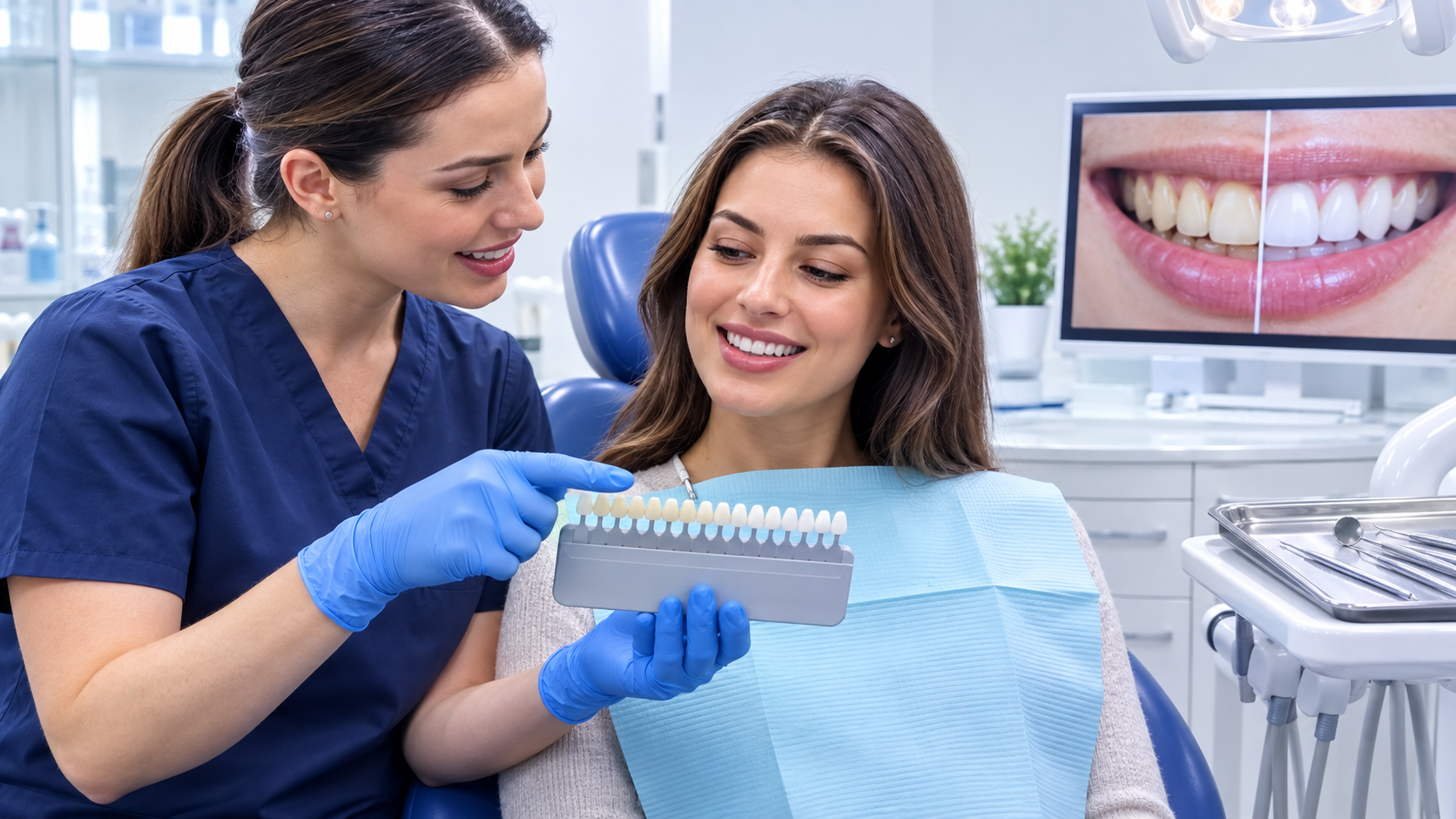
Assessment is not an administrative step on the way to the treatment people actually came for. It is the service that determines whether any of the others are appropriate, and it is the single stage most worth understanding in advance.
The purpose is threefold. First, to establish that the teeth and gums are healthy enough for a cosmetic procedure. Teeth Whitening applies an active agent to living tissue, and that tissue needs to be in reasonable condition for the treatment to be sensible. Untreated decay, gum inflammation, exposed root surfaces, cracked enamel and failing restorations all change the picture, and none of them are reliably visible to the person concerned in a bathroom mirror.
Second, to identify what kind of discolouration is present. This is the part most people have never considered, and it is the part that governs the result more than any other single factor. Staining that sits on and just within the outer surface of the tooth behaves quite differently from discolouration originating within the tooth structure itself. The two can look similar from the outside and respond very differently to the same treatment.
Third, to establish what the person is actually hoping for. This sounds soft, but it is where most later disappointment is either prevented or created. Someone hoping their teeth will look fresher in photographs is asking for something quite different from someone who has a specific shade in mind, and those two conversations should not end in the same place.
What is looked at during an assessment
- General oral health — the overall condition of the teeth and gums, and whether anything needs attention in its own right before cosmetic treatment is considered.
- The gum margins — recession, inflammation and bleeding all matter, both for comfort during treatment and for whether treatment should proceed at all.
- Enamel condition — thickness, wear, erosion and any visible cracks or chips.
- The type and distribution of staining — whether it is even across the smile or concentrated in particular areas, and whether it reads as surface staining or something deeper.
- Existing dental work — the position, visibility and shade of any fillings, crowns, veneers or bridges within the smile line.
- Sensitivity history — whether the teeth already react to hot, cold, sweet or acidic stimuli, and how strongly.
- Previous whitening — what was used, when, how the teeth responded, and how long any change lasted.
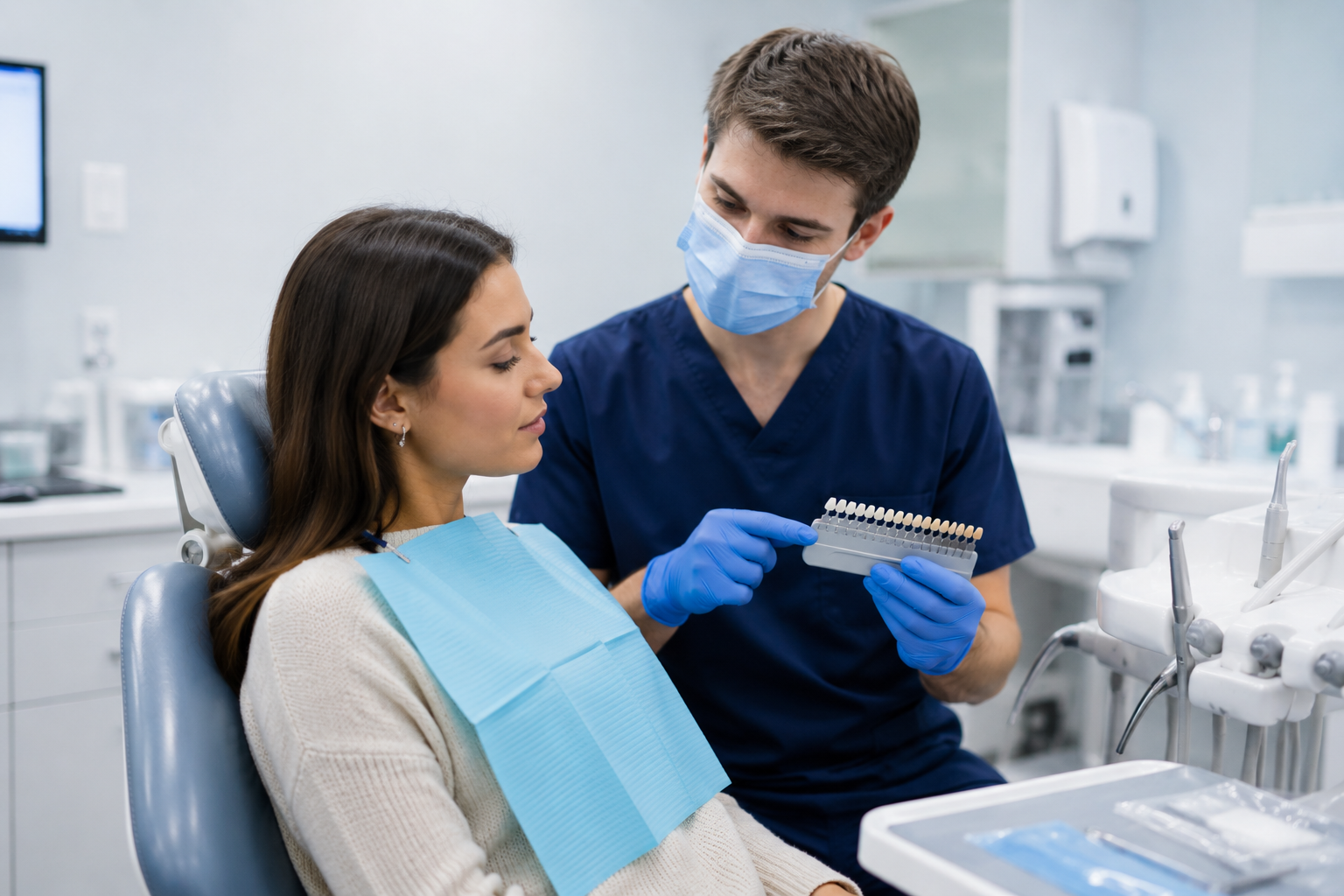
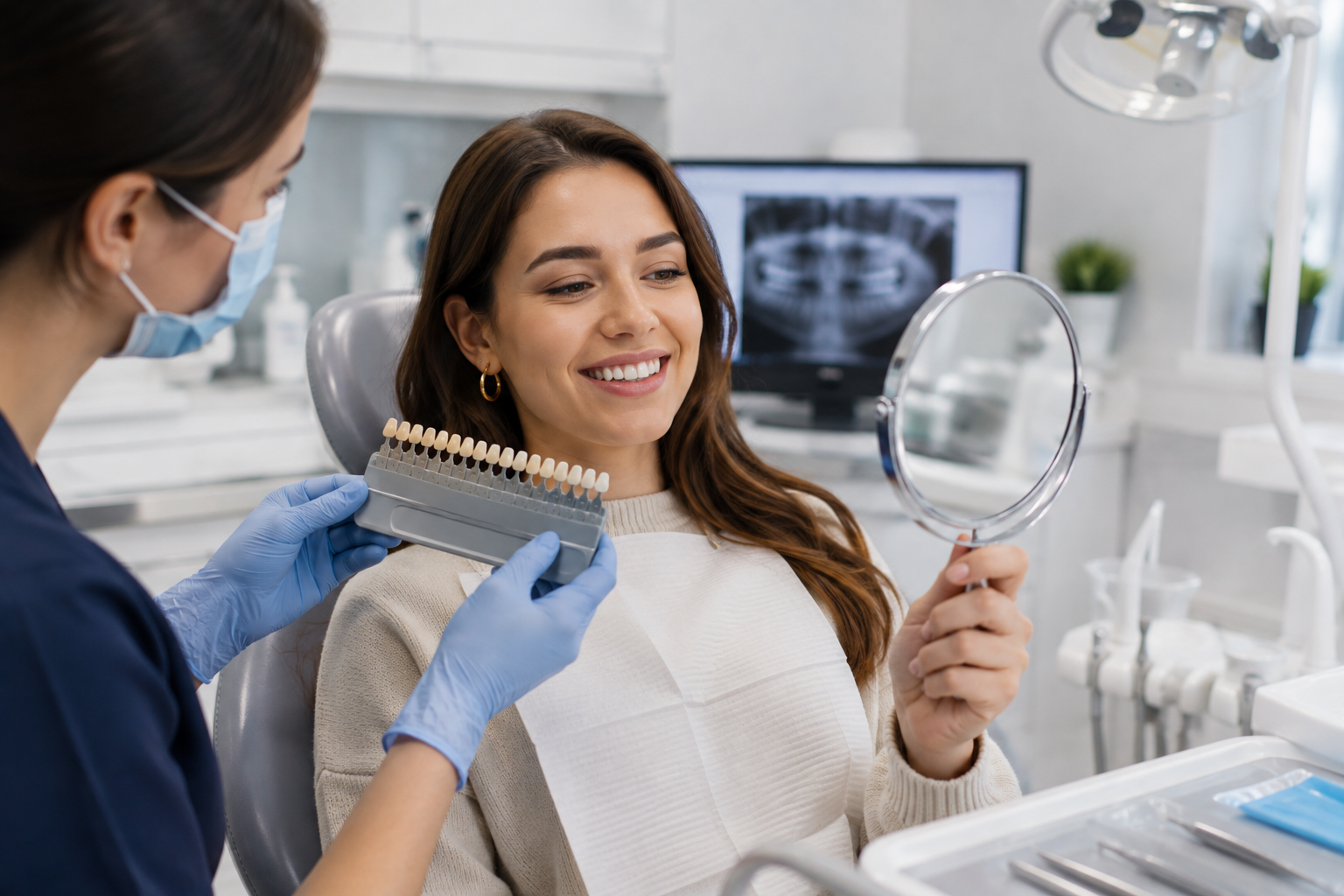
- The starting shade — recorded properly, so that the change can later be assessed against something objective rather than a memory.
Why the starting shade is recorded
Recording the shade beforehand sounds like a formality and is anything but. Human memory for colour is poor and highly suggestible; within a fortnight most people cannot accurately recall what their teeth looked like before treatment, and so lose the ability to judge the change fairly in either direction. A recorded starting point removes the argument and makes an honest review possible afterwards.
If you are considering whitening and want to understand whether treatment is appropriate for your teeth, a Teeth Whitening Consultation provides an opportunity to discuss your starting shade, sensitivity, existing dental work and realistic treatment expectations before proceeding.
Teeth Whitening for Tea and Coffee Drinkers
Tea and coffee are the most common contributors to gradual tooth discolouration in adults, for an unglamorous reason: sheer frequency. Very few dietary habits are repeated as reliably, as often, and across as many years.
Both drinks contain tannins naturally occurring plant compounds that bind readily to the proteins in the film covering the tooth surface. Every cup deposits a small amount of pigment. Almost all of it is removed by normal brushing and by saliva. What is left behind is a residue so slight that it is invisible on any given day, and that is precisely why the change goes unnoticed. Discolouration from tea and coffee is not something that happens to your teeth; it is something that accumulates on them, over thousands of small exposures, until a photograph or an unflattering mirror makes the cumulative total obvious.
Why sipping is the real problem
The single most useful thing a tea or coffee drinker can understand is that contact time matters more than volume. This is counter-intuitive and it changes how people think about their habit.
A strong coffee drunk in ten minutes delivers a large dose of pigment over a short window, after which saliva begins clearing it. The same coffee sipped slowly across two hours at a desk keeps the tooth surface bathed in pigment for the whole period, and repeatedly re-coats it just as saliva starts to make progress. The second pattern stains considerably more, despite being the same drink. Anyone who works at a desk with a mug beside them is following the second pattern by default.
This matters because it identifies something changeable. Very few people need to give up coffee. Drinking it over a shorter window, following it with water, or not topping the same mug up across a morning addresses much of the problem without anyone giving up what they enjoy.
What whitening can reasonably offer this group
Staining associated with tea and coffee is generally of the type that responds most predictably to whitening. It is largely surface and near-surface pigment, and it is precisely what the treatment is designed to act on. This is the group most likely to be pleased with the outcome, and the group for whom a confident conversation about a visible change is most defensible.
The honest caveat is that it returns. The habit that produced the staining is usually still in place the week after treatment, and it goes on working at the same rate it always did. This is not a failure of the treatment; it is arithmetic. For regular drinkers, the realistic frame is maintenance over years rather than a single permanent correction, and anyone who is not told that upfront has been sold something slightly different from what they are buying.
Teeth Whitening for Smokers and Tobacco Staining
Tobacco produces some of the most persistent surface staining seen on natural teeth. It differs from dietary staining in both character and depth. Where tea and coffee tend to produce a fairly even dulling, tobacco staining often develops a distinct yellow-brown quality, frequently heaviest on the inner surfaces of the lower front teeth and around the gum margins, and it resists ordinary brushing in a way that dietary staining generally does not.
The reason is chemical. Tar is sticky and adheres tenaciously to enamel and to any roughened or porous areas of the tooth surface. Nicotine, colourless in itself, oxidises on contact with air into a yellowing residue. Together they build a layer that is both more tenacious and more deeply infiltrated than the pigment left by a drink.
What is realistic here
Improvement is achievable in many cases and is often substantial, but this is the group where honest expectation-setting matters most, and where the variation between individuals is widest. Some of that variation depends on how long the habit has been in place. Some depends on whether the staining has been left undisturbed for years or has been regularly reduced by professional cleaning. Some depends on the condition of the enamel underneath, which heavy staining can conceal entirely until it is removed.
There is also a sequencing point worth knowing. Where staining is heavy and largely sitting on the surface, professional cleaning before whitening can make a considerable difference to the outcome, because the whitening agent then reaches the tooth rather than the deposit covering it. Whether that is appropriate is a clinical judgement, but it is a reasonable question to raise at assessment.
The uncomfortable part
Continuing to smoke after treatment will shorten how long the result lasts, and it will do so faster than dietary staining would. This is not a moral observation and it is not an attempt to extract a commitment to quit; it is simply the mechanism, and a provider who does not mention it is withholding something the person needs in order to decide whether the treatment is worth it to them.
A second consideration sits outside cosmetics altogether. Tobacco use is associated with gum disease and with changes to the soft tissues, and an assessment looks at those tissues. Occasionally it raises something that matters more than tooth colour — a good outcome, even when it is not the one anybody came for.
Teeth Whitening for Younger Adults
A significant proportion of enquiries about Teeth Whitening come from adults in their late teens, twenties and early thirties. The pattern is different from that of older patients, and treating it as though it were the same is a mistake.
Younger adults usually present with mild lifestyle staining rather than deep or long-established discolouration-a few years of coffee, energy drinks, red wine, cola or strongly coloured food, layered on enamel that is generally in good condition and has not yet thinned appreciably with age. For a more focused look at the considerations involved, including expectations, enamel maturity and existing restorations, see Teeth Whitening for Young Adults.
Why the starting point changes the conversation
When enamel is healthy and the discolouration is recent, there is less to remove and less standing in the way of a good result. That is the encouraging part. The less encouraging part is that a tooth already close to its natural shade has less distance available to travel, and some younger patients are surprised by that. If your teeth are already reasonably light, the visible change may be more modest than the change achieved by someone starting from heavy staining — not because the treatment worked less well, but because there was less to correct.
This is worth saying plainly, because expectations in this group are often shaped by images that whitening could never have produced-veneer cases, lighting effects, edited photographs. Natural teeth do not reach those shades, and any treatment promising they will is not being straight with you.
Suitability considerations specific to younger patients
- Enamel maturity — enamel continues to mineralise for a period after teeth erupt, and very young teeth may be more reactive to treatment.
- Orthodontic history — recent brace removal can leave uneven surface appearance that settles over time, and whitening immediately afterwards may lock in an uneven picture.
- Existing restorations — even young mouths often have tooth-coloured fillings in visible positions, and those will not lighten with the teeth around them.
- Developmental marks — white or mottled patches present since the teeth came through are a different phenomenon from staining and behave differently under whitening.
- Realistic framing — the aim is a fresher, more even version of your own teeth, not a shade borrowed from a photograph.
None of this argues against whitening for younger adults. It argues for the same assessment everybody else gets, and against the assumption that a young mouth is automatically a straightforward one.
Teeth Whitening for Sensitive Teeth
Sensitivity is the most common reason people decide against whitening, and it is very often decided on without ever being discussed with anyone qualified to comment. A great many people have concluded privately that whitening is not for them, on the basis of a twinge at cold water and an assumption about what the treatment would feel like.
The assumption deserves a proper answer rather than reassurance. Sensitivity is real, it is common, and whitening can temporarily increase it. It is also frequently manageable, and it is not in itself an automatic barrier to treatment.
For a more detailed discussion of the causes of sensitivity and how whitening can be adapted around it, see Teeth Whitening for Sensitive Teeth.
What causes sensitivity in the first place
Enamel is the hard outer covering of the tooth and contains no nerves. Beneath it lies dentine, which is riddled with microscopic tubules running inward towards the pulp. When dentine is exposed-through enamel wear, erosion, abrasion from over-vigorous brushing, or gum recession uncovering root surfaces that were never enamel-covered to begin with-fluid within those tubules can move in response to temperature change, air, sweetness or acidity. That movement is what registers as the short, sharp sensation people describe.
Understanding this explains why sensitivity varies so widely between people and even between teeth in the same mouth. It depends on how much dentine is exposed and where, which is an anatomical question rather than a matter of tolerance.
Why whitening can increase it temporarily
Whitening involves an active agent held in sustained contact with the tooth. In some people this makes the teeth transiently more responsive to stimuli. Where it happens it is generally a passing effect that settles, rather than a lasting change to the tooth-but "generally" is doing real work in that sentence, and how noticeable it is varies considerably from person to person.
How treatment is adapted for sensitive teeth
- Sensitivity is established before anything begins — which teeth, what triggers it, how strongly, and how long it lasts each time.
- Causes are looked for rather than assumed — recession, wear, erosion, cracks and untreated problems each imply a different response, and some need attention in their own right.
- Pacing is adjusted — a more measured approach spread over a longer period is often more comfortable than the same treatment compressed.
- Comfort is actively monitored — you are asked how it feels during treatment, and discomfort should be reported at the time rather than endured.
- Stopping remains an option — treatment that becomes uncomfortable can be halted, and that decision should carry no awkwardness.
Sensitivity that is severe, persistent, spontaneous, or localised to one tooth is a different matter from generalised mild sensitivity, and it should be assessed rather than worked around. It may point to a dental problem that needs attention independently of any cosmetic treatment. Pain that wakes you, lingers after the trigger is removed, or comes without a trigger at all is not something to plan a whitening appointment around.
Teeth Whitening for Age-Related Discolouration
Some discolouration has nothing to do with diet, habits or hygiene. It is simply what happens to teeth over decades, and it affects people who have looked after their mouths impeccably.
Two changes run in parallel. Enamel gradually thins through a lifetime of chewing, brushing and exposure to dietary acids. At the same time the dentine beneath it slowly becomes thicker and more yellow, as the tooth lays down additional dentine internally over the years. The combination-a thinner, more translucent outer layer over a darker, more opaque inner one-produces a tooth that looks progressively more yellow, entirely independently of anything the person has eaten or drunk.
What this means for treatment
Age-related change is not staining in the ordinary sense. There is no deposit sitting on the surface to remove; the colour comes from within the tooth structure. This does not mean whitening has nothing to offer, but it does mean the conversation should be more measured. Where discolouration is genuinely intrinsic, results tend to be more gradual and more variable than they are with surface staining, and honest assessment is more important than usual.
In practice most older patients present with both: decades of tea, wine and food produce surface staining while enamel thinning produces intrinsic change beneath it. The surface component often responds well, and removing it can reveal a noticeably fresher appearance even where the underlying shade has shifted little. Separating the two at assessment is what makes a useful prediction possible.
Additional considerations that come with age
- Accumulated dental work — a mouth with several decades of history usually contains restorations, and older restorations are more likely to sit in visible positions.
- Gum recession — exposed root surfaces are dentine rather than enamel, do not respond to whitening the way crowns of teeth do, and are frequently more sensitive.
- Enamel wear — worn biting edges can appear more translucent and sometimes darker after whitening rather than lighter, because there is less enamel to reflect light.
- Existing conditions and medication — dry mouth in particular reduces the natural clearance of pigment and affects both staining and comfort.
Teeth Whitening Alongside Existing Dental Work
This is the limitation that causes more post-treatment disappointment than any other, and it is entirely avoidable through a five-minute conversation beforehand.
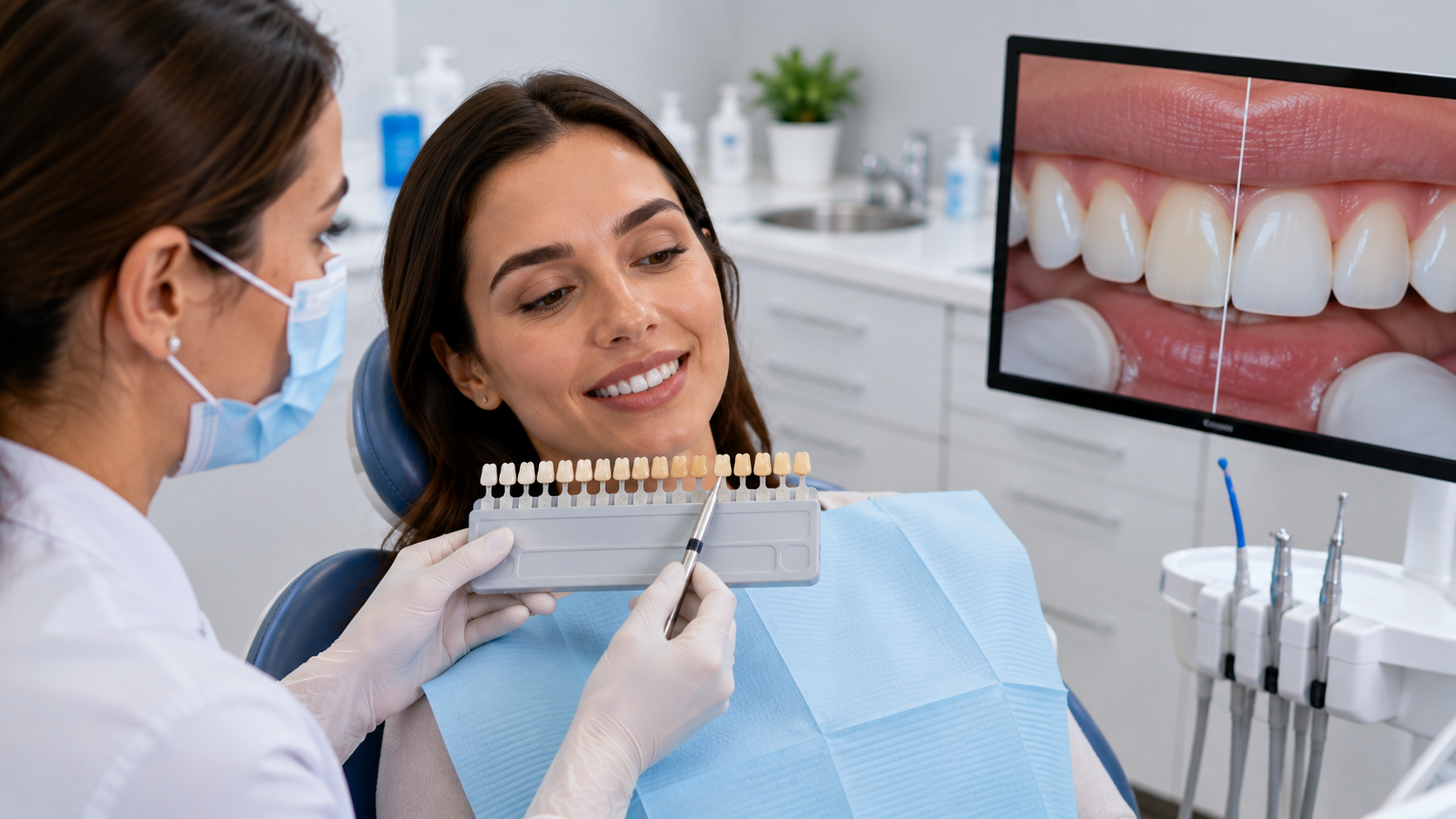
Whitening acts on natural tooth structure. It does not act on manufactured dental materials. Composite fillings, porcelain crowns, veneers and bridge components were all made to match the shade of the surrounding teeth at the time they were placed. If the natural teeth around them lighten and the restorations do not, a match that previously looked seamless begins to stand out. The restoration has not changed; everything around it has.
| Material | Responds to whitening? | What this means in practice |
|---|---|---|
| Natural enamel | Yes | The intended target of the treatment. |
| Natural dentine (exposed root) | Limited and variable | Exposed root surfaces may lighten less than the crowns of the teeth, leaving a visible gradient at the gum margin. |
| Composite fillings | No | Keep their placed shade. Visible front fillings may become more obvious after treatment. |
| Porcelain crowns | No | Retain the manufactured shade entirely, regardless of the teeth beside them. |
| Veneers | No | Made to a chosen shade that whitening will not alter. |
| Bridges | No | Visible components behave like other restorative materials. |
None of this makes whitening unsuitable for people with dental work-a great many people with restorations proceed and are pleased with the outcome. What it makes essential is that the position and visibility of that work is identified before treatment, so the likely appearance afterwards is understood rather than discovered in a mirror.
Where restorations are prominent within the smile, the sequencing question also arises: some people choose to whiten first and then consider whether existing work should be reviewed against the new shade. Whether that is appropriate, and what it would involve, depends on a clinical examination of your specific circumstances and cannot sensibly be decided from general information on a web page.
In-Clinic Treatment, Home Approaches and Maintenance
Alongside the question of who a service is for sits the question of how it is delivered. Three broad approaches are commonly discussed, and they differ in supervision, pacing and the degree to which they can be adapted to the individual.
Supervised in-clinic treatment
Carried out in a single appointment following assessment, with the gums and soft tissues protected and the process monitored throughout. The change is visible on the day. The advantages are supervision, the ability to adapt as treatment proceeds, and the fact that a professional has looked at the teeth before anything was applied.
Supervised home approaches
Carried out by the person over a longer period, following an assessment and using an approach agreed with a professional. Convenience and flexibility are the appeal, and the gradual pace suits some people with sensitivity. Consistency depends heavily on how carefully the routine is followed.
Maintenance and top-up treatment
Periodic treatment for people who have whitened before and want to hold the appearance as everyday habits gradually reassert themselves. Usually shorter and less involved than an initial course, because it is correcting drift rather than establishing a change.
Over-the-counter products
Widely available products sit outside all three categories and deserve a straight comment. They are easy to obtain and vary enormously in what they set out to do. Some are polishing agents that address surface film; some are genuine whitening products at low concentration; some are neither.
The substantive difference is not strength but the absence of any examination. Nobody has checked the gums, looked for decay, noted visible restorations, or established whether the discolouration is the type that responds. A problem can go unnoticed while the surface is worked on, and abrasive products used enthusiastically over years can contribute to enamel wear-which makes teeth look more yellow, not less.
What every service on this page includes
- Suitability assessment
Teeth and gums examined, dental work noted, discolouration type identified, sensitivity history taken.
- An honest expectation conversation
What you are hoping for, set against what is realistically achievable for your teeth specifically.
- Shade recorded before treatment
An objective starting point, so the change can be judged fairly afterwards.
- Preparation and protection
Tooth surfaces prepared for even contact; gums and soft tissues shielded so the agent acts only where intended.
- Treatment applied to the agreed plan
Placement, coverage and timing according to what was agreed for your teeth rather than a standard template.
- Comfort monitored throughout
You are asked how it feels as treatment proceeds, and the approach is adjusted or stopped if needed.
- Result reviewed against the starting record
The outcome compared with the recorded starting shade and the expectations discussed at the outset.
- Aftercare guidance provided
Specific, practical advice for the period afterwards, and a clear route back if anything is not right.
Choosing Between Services
Most people fall into more than one of the groups above. A forty-five-year-old coffee drinker with a crown on a front tooth and mild sensitivity is a typical patient, not an unusual one. The categories organise the conversation; they are not boxes.
| If this describes you | The most relevant discussion | The point most often missed |
|---|---|---|
| Daily tea or coffee, gradual dulling | Surface staining and maintenance planning | Contact time matters more than quantity; the result needs maintaining. |
| Current or former smoker | Extent of tobacco staining; cleaning before whitening | Outcomes vary widely and continued smoking shortens them. |
| Under 30, mild lifestyle staining | Realistic range of change from an already-light starting point | Less distance to travel; online reference images are usually not whitening results. |
| Teeth react to cold or sweet | Cause of the sensitivity; pacing and monitoring | Sensitivity is not an automatic barrier, but its cause should be found. |
| Over 60, teeth yellowing with age | Separating intrinsic change from surface staining | Both are usually present; they respond differently. |
| Visible crowns, veneers or front fillings | Position and visibility of restorations; sequencing | Restorations will not lighten, and may stand out afterwards. |
Questions worth asking at assessment
- What type of discolouration do I actually have, and how can you tell?
- What sort of change is realistic for my teeth specifically?
- Which of my restorations will be visible if the teeth around them lighten?
- What will you do if I become uncomfortable partway through?
- How will we judge afterwards whether it worked?
- What happens if the result falls short of what we discussed?
- Is there anything you would want to treat before we consider whitening?
A provider who welcomes these questions is a good sign. A provider who deflects them is telling you something useful.
What These Services Do Not Do
Being clear about limits is part of describing a service properly.
- Whitening does not treat dental disease. It changes appearance. It has no effect on decay, gum disease or infection, and it is not a substitute for the routine care that keeps a mouth healthy.
- It does not change the shape, size or alignment of teeth. Crowding, spacing, chips and wear are unaffected. A lighter crooked tooth is a lighter crooked tooth.
- It does not lighten dental materials. Every restoration in your mouth will finish the same shade it started.
- It does not produce a single standard shade. Everyone starts somewhere different and finishes somewhere different, and no responsible provider will promise a specific end point.
- It is not permanent. The habits that caused the original discolouration continue afterwards and go on working at the same rate.
- It does not suit everyone. Some dental situations make whitening inappropriate, either for the time being or altogether.
A service described only by what it achieves is not described honestly. Knowing these limits beforehand is what allows a result to feel like a success rather than a shortfall.
Common Questions About Teeth Whitening Services
Which Teeth Whitening service is right for me?
That depends on the cause of your discolouration, the condition of your teeth and gums, any sensitivity you experience, and the dental work already in place. Most people fit more than one of the categories described above, which is why the assessment exists — it establishes which considerations actually apply to you rather than which sound closest.
Do I need an assessment if I have had whitening before?
Yes. Mouths change, restorations age, gums recede and sensitivity can develop where there was none. Previous experience is genuinely useful information and should be raised, but it does not replace looking at the teeth as they are now.
Can I have whitening if I have a crown on a front tooth?
Often, yes — but the crown will not change colour with the teeth around it. Whether that produces an acceptable result depends on how visible the crown is and how much the surrounding teeth lighten. It is a conversation to have before treatment, not afterwards.
How long does treatment take?
This depends on the approach agreed after assessment. Supervised in-clinic treatment is typically completed within a single appointment; home-based approaches run over a longer period. The timescale should be explained to you as part of planning rather than assumed in advance.
Will whitening make my sensitivity worse permanently?
Where increased sensitivity occurs it is generally temporary and settles. That said, existing sensitivity should be assessed rather than assumed to be ordinary, because its cause affects both how treatment should be paced and whether it is appropriate at all.
Is professional treatment different from products I can buy?
The most meaningful difference is assessment and supervision, not strength. A professional service establishes what is causing the discolouration and whether the mouth is healthy before anything is applied, and adapts as treatment proceeds. A product bought off a shelf does none of that.
What if I am not happy with the result?
Say so, and say so early. A result reviewed against a recorded starting shade can be discussed objectively. Whether anything further is appropriate depends on why the outcome fell short — an unrealistic expectation, a restoration that behaved exactly as predicted, and a treatment that underperformed are three different situations requiring three different responses.
Where to Go From Here

The services described here share more than they differ. Each begins with an examination rather than an assumption, each is planned around one particular mouth, and each ends with an honest review. What changes is the emphasis — pacing for a sensitive patient, expectation-setting for a smoker, a restoration audit for someone with visible dental work. If you are weighing up whether Teeth Whitening is worth pursuing, the useful next step is not choosing from a list but having your teeth looked at, so the choice rests on what is actually there.